Why WASH Startups Fail: The 95% Graveyard and LooCafe's Survival Formula
Why WASH Startups Fail: The 95% Graveyard and LooCafe's Survival Formula
The global sanitation industry has a dirty secret: 95% of WASH startups fail within 5 years. From San Francisco's infamous $1.7 million toilet to China's $7 billion "Toilet Revolution" that built units nobody maintains, public toilet infrastructure is a graveyard of good intentions and wasted capital.
LooCafe's survival—let alone growth to 450+ units across 10+ Indian cities—isn't just success. It's a miracle.
This article examines why sanitation ventures fail globally and how LooCafe defied the odds.
Part I: The Global Toilet Failure Hall of Fame
San Francisco: $1.7 Million for a Single Toilet
In 2022, San Francisco approved $1.7 million for one public toilet in Noe Valley. The timeline? 3+ years. The reason for the astronomical cost?
- 18 different city departments had to approve designs
- Environmental review alone took 14 months
- Labor union requirements added $400,000
- ADA compliance review: another 6 months
- Historical district review for a toilet in a park
The lesson: Government fragmentation doesn't just slow projects—it makes them economically impossible.
United Kingdom: The Great Toilet Extinction
British public toilets declined from over 6,000 in the 1990s to under 3,000 today—a 50% extinction rate. The culprit wasn't lack of demand but fragmented responsibility:
- Ofwat regulates water
- Environment Agency handles discharge
- Local councils (all 333 of them) own facilities
- Department of Health sets hygiene standards
When toilets cost money but generate no revenue under traditional models, cash-strapped councils closed them first.
Japan: The Exception That Proves the Rule
Tokyo maintains over 17,000 spotless public toilets. How? The Tokyo Toilet Project demonstrated that when a single entity (Nippon Foundation) coordinates design, construction, and maintenance with municipal backing, results are transformative.
The difference: One stakeholder managing the entire value chain.
China: $7 Billion Built, Nobody Maintains
China's "Toilet Revolution" (2015-2020) spent $7.06 billion building hundreds of thousands of public toilets. The result? Many now sit abandoned or poorly maintained because:
- Construction funding came from one ministry
- Maintenance responsibility fell to another
- Revenue model was never established
- Local governments prioritized building (visible) over operating (invisible)
Part II: Why Government Fragmentation Kills Toilets
The 7+ Department Problem
In most countries, public sanitation involves at minimum:
| Department | Responsibility |
|---|---|
| Water Authority | Supply connections |
| Sewage/Environment | Discharge permits |
| Urban Planning | Site approvals |
| Health | Hygiene standards |
| Municipal Works | Construction oversight |
| Tourism (sometimes) | High-traffic areas |
| Women & Child (sometimes) | Safety standards |
India is worse: The Ministry of Jal Shakti, Ministry of Housing & Urban Affairs, State Urban Development Departments, Municipal Corporations, Cantonment Boards, and Tourism Departments all have overlapping mandates.
The CAPEX Trap
Government budgets reward building over operating:
- Capital expenditure (CAPEX) creates visible outputs: new buildings, ribbon-cutting ceremonies
- Operational expenditure (OPEX) is invisible: cleaning, repairs, staff salaries
- Politicians get credit for inaugurations, not for toilets that stay clean
Result: Governments build toilets they can't afford to maintain.
Singapore: The Exception
Singapore's PUB (Public Utilities Board) manages water supply, sewerage, and drainage under one entity. Public toilets are integrated into this unified system.
Key insight: Integration works. Fragmentation fails.
Part III: Global Non-Sewered Sanitation R&D ($200M+)
Global non-sewered sanitation research programs have invested over $200 million since 2011. The results are instructive.
What Worked
- Technology development: ISO 30500-aligned systems exist
- Research: We understand non-sewered sanitation better than ever
- Standards: An international standard (ISO 30500) for onsite circular toilets now exists
What Didn't Scale
- Standalone solar prototypes: Brilliant technology, $10,000+ per unit
- Nano-membrane prototypes: Lab success, field struggle
- Technology-first prototypes: Technology-first, market-last approach
What Actually Worked: Sanergy (Kenya)
Sanergy in Nairobi succeeded where others failed by:
- Owning the entire value chain (collection to processing)
- Creating revenue from waste (fertilizer, animal feed)
- Starting with business model, not technology
- Operating 3,900+ toilets serving 130,000+ daily users
The pattern: Business model innovation, not just technology innovation.
Part IV: The Four Traps That Kill WASH Startups
Trap 1: PPP Partnership Trap
Public-Private Partnerships (PPPs) in sanitation fail because:
- Government changes: New administration, new priorities
- Payment delays: Municipal budgets are perpetually strained
- Scope creep: "While you're at it, can you also..."
- Risk asymmetry: Private partner bears risk, government controls decisions
Bolivia's Cochabamba Water War showed what happens when PPPs go wrong: riots, deaths, and complete rejection of private sanitation.
Trap 2: Technology Trap
Startups that lead with technology often fail because:
- Customers buy outcomes, not inputs
- ISO30500 compliance doesn't create revenue
- High-tech toilets need high-touch maintenance
- "The best toilet is the one that gets used"
Trap 3: Procurement Trap
Government procurement processes:
- Take 18-36 months from RFP to contract
- Favor lowest bidder, not best solution
- Require expensive compliance documentation
- Change requirements mid-process
By the time a startup wins a government contract, they've often burned through their runway.
Trap 4: Maintenance Trap
The "build it and they will come" fallacy:
- 70% of public toilet failures are maintenance-related
- Cleaning requires daily attention; investors want quarterly reports
- One bad experience ruins a toilet's reputation permanently
- There's no "move fast and break things" in sanitation
Part V: LooCafe's Survival Formula
How Did LooCafe Survive?
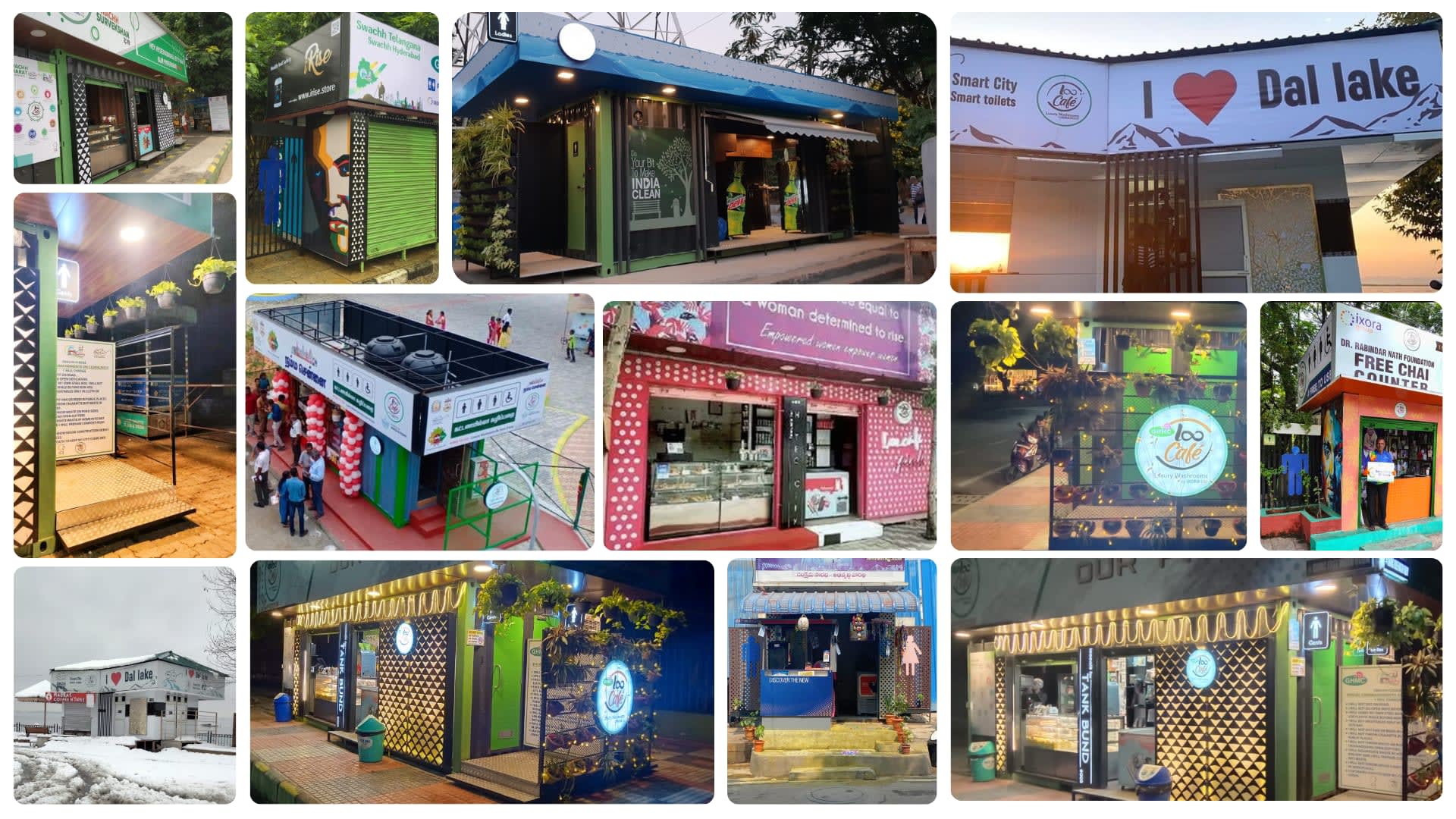
LooCafe—launched in 2018-2019—has grown to 450+ units serving millions annually. In an industry with 95% failure rates, this is extraordinary. Here's how:
1. The Café Model: Revenue Without Government Dependency
LooCafe's core innovation isn't toilet technology—it's business model architecture:
Revenue Mix:
├── 70% → Café/Kiosk sales (tea, snacks, essentials)
├── 20% → Advertisement panels
└── 10% → Value-added services (WiFi, charging)
Critical insight: The toilet is free. The revenue comes from everything around it.
This means:
- No dependency on government payments
- No user fees that deter usage
- Self-sustaining unit economics
- Scalable without subsidy
2. One Stakeholder Model
Unlike fragmented government approaches, LooCafe operates as a single stakeholder:
- Owns the unit design and IP
- Deploys prefabricated containers (2-3 days installation)
- Operates through local micro-entrepreneurs
- Maintains through standardized SOPs and IoT monitoring
- Monetizes through integrated revenue streams
The organism model: Each unit functions as an independent economic entity.
3. Operator Empowerment
LooCafe doesn't just build toilets—it creates toilet entrepreneurs:
- Local vendors run the café component
- Revenue sharing aligns incentives
- "Turning street hawkers into toilet entrepreneurs"
- Community ownership, not government ownership
4. Technology as Enabler, Not Product
LooCafe's Toilet Tech platform provides:
- Real-time monitoring
- Maintenance alerts
- User feedback loops
- Data for advertisers
But technology serves the business model—it doesn't define it.
Part VI: ReFlow and the Next Evolution
LooCafe's success enabled the development of ReFlow Toilets—taking the model further with:
- ReFlow Circular technology: Advanced 8-stage treatment, zero discharge, ISO 30500 aligned closed-loop water recovery
- District-level deployment: Scaling from individual units to municipal infrastructure
Read the full analysis: Why Public Toilets Fail Globally
The ReFlow Circular unit at Lumbini Park, Hyderabad—launched November 2025—combines LooCafe's proven business model with closed-loop onsite water treatment and reuse, visited by international sanitation delegations.
The Survival Formula
Why do WASH startups fail? They approach sanitation as:
- A technology problem (it's a business model problem)
- A government partnership opportunity (it's a government dependency trap)
- A one-time deployment (it's a continuous operation)
- A charity play (it's an economic engine)
Why did LooCafe survive?
- Revenue first: Built sustainable economics before scaling
- Independence: Doesn't depend on government payments
- Integration: One stakeholder for the entire value chain
- Incentive alignment: Operators succeed when toilets succeed
- Continuous improvement: IoT-enabled, data-driven operations
In the graveyard of WASH startups, LooCafe's survival isn't luck—it's architecture.
Learn More
- LooCafe Website: loocafe.com
- ReFlow Toilets: reflowtoilets.com
- LooCafe ReFlow Toilet: loocafe.com/reflow-toilet
- Related Article: Why Public Toilets Fail Globally
This article is part of a cross-site research series examining global sanitation infrastructure challenges and solutions. For technical specifications on ReFlow Circular technology, visit ReFlow Toilets.
Subscribe to our Insights
Get the latest updates on sanitation technology and urban policy.