The Business Case for Public Toilets: ROI, PPP Models, and Sustainable Sanitation
The Business Case for Public Toilets: ROI, PPP Models, and Sustainable Sanitation
Ask most municipal officials about public toilets, and you'll hear the same refrain: "They're too expensive, impossible to maintain, and no one wants to pay for them."
This conventional wisdom has left billions of people without access to clean, safe public sanitation—and cost the global economy $260 billion annually.
But here's the truth that's revolutionizing urban infrastructure: public toilets can be profitable, sustainable, and scalable—when designed with the right business model.
Every dollar invested in sanitation returns more than five dollars in economic benefits. The portable toilet market is projected to grow from USD 19.2 billion (2024) to USD 34.69 billion (2032). And companies like LooCafe are proving that premium public restrooms can generate sufficient revenue to fund their own operations—and then some.
This isn't charity. This is smart infrastructure investment.
Let's break down the business case for public toilets—the ROI data, revenue models, partnership structures, and financial strategies that make sustainable sanitation not just possible, but profitable.
The Economic Foundation: Why Sanitation is a High-ROI Investment
The Global ROI: $1 Returns $5+
The World Bank, WHO, and other international organizations consistently document sanitation's exceptional return on investment:
Direct Economic Returns:
- Healthcare Cost Savings: Reduced treatment for waterborne diseases (diarrhea, cholera, typhoid)
- Productivity Gains: Fewer sick days, more working hours
- Premature Death Avoidance: Economic value of lives saved
- Tourism Revenue: Cleaner cities attract visitors and business travelers
Indirect Economic Benefits:
- Property Values: Real estate near quality sanitation facilities appreciates
- Business Activity: Foot traffic to nearby shops and services increases
- Education Outcomes: School attendance improves (especially girls with MHM facilities)
- Gender Equity: Women's workforce participation increases with safe public facilities
The Calculation: For every $1 invested in sanitation, society gains $5+ in economic benefits.
In India specifically:
- ODF households save ₹50,000 annually on health expenses
- 6.4% of GDP is lost due to inadequate sanitation (World Bank)
- ₹2.4 lakh crore ($53 billion) annual economic cost pre-Swachh Bharat Mission
The Market Opportunity: Billions in Growth
Public Toilet Market:
- 2024: USD 1.3-3.5 billion (varying estimates)
- 2033: USD 3.05-6.2 billion
- CAGR: 7.2-9.1%
Portable Toilet Market:
- 2024: USD 19.20 billion
- 2032: USD 34.69 billion
- CAGR: 7.7%
- Leading Region: Asia Pacific (32.91% market share)
Smart Toilet Market:
- 2024: USD 10.11 billion
- 2030: USD 16.09 billion
- CAGR: 8.04%
Growth Drivers:
- Urbanization (68% of world population urban by 2050)
- Government sanitation initiatives (Swachh Bharat Mission: ₹1.4 lakh crore for Phase 2)
- Post-COVID hygiene awareness
- Smart city integration
- Climate finance for green infrastructure
- SDG 6 push (universal sanitation by 2030)
The Takeaway: Sanitation is a growth market with policy tailwinds, demographic demand, and proven ROI.
The Business Model Challenge: Why Traditional Public Toilets Fail
Before exploring successful models, let's understand why traditional public toilets often fail:
The Vicious Cycle of Decline
Phase 1: Initial Construction
- Government builds public toilet with capital budget
- Modern facility, well-maintained initially
- Users appreciate the infrastructure
Phase 2: Budget Constraints
- Operational costs exceed allocated maintenance budget
- Cleaning frequency reduced
- Repairs delayed
- Supplies (soap, toilet paper) inconsistent
Phase 3: User Avoidance
- Facility becomes dirty and unpleasant
- Users stop coming
- Revenue (if any) drops
- Further justifies budget cuts
Phase 4: Abandonment
- Facility effectively non-functional
- Becomes homeless shelter or vandalized
- Government declares "public toilets don't work"
- Cycle repeats with next construction project
The Root Problems
1. Cost-Center Mentality: Traditional approach treats toilets as pure expense, not revenue-generating assets.
2. Insufficient Maintenance Funding: Capital budgets for construction ≠ operational budgets for maintenance. The latter often forgotten or underfunded.
3. No Accountability: No entity "owns" the toilet's success. Municipal workers have no incentive to maintain quality.
4. User Disconnect: Free access means no direct revenue; users have no financial stake in facility quality.
5. Political Disinterest: Ribbon-cutting for new toilets wins votes; ongoing maintenance doesn't. Politicians prioritize construction over operations.
The Solution: Business models that align incentives, generate revenue, and create accountability.
Successful Business Models: What Actually Works
Model 1: Public-Private Partnership (PPP)
Structure: Private entity finances, constructs, operates, and maintains public toilet under contract with municipality.
Revenue Sources:
- Municipal fees (guaranteed payment per facility or user)
- Advertising (exterior walls, digital screens)
- User fees (where culturally acceptable)
- Retail integration (kiosks, vending machines)
- WiFi services (partnerships with telecom providers)
Risk Allocation:
- Private Sector: Construction risk, operational efficiency, maintenance quality
- Public Sector: Land provision, permitting, regulatory compliance
Example: GARV Toilets (India)
Model:
- Partnerships with municipal corporations
- GARV installs, operates, and maintains facilities
- Revenue from advertising and business partnerships
- Additional services: WiFi hotspots, mobile charging, small kiosks
WASH Hubs:
- Suite of complementary services: laundry, showers, water ATMs
- Real estate for advertisers
- Cross-subsidization: High-traffic locations fund underserved areas
Advantages:
- No upfront capital from municipality
- Performance-based contracts ensure quality
- Private sector efficiency and innovation
- Scalable rapidly without government bureaucracy
Challenges:
- Contract negotiation complexity
- Ensuring public interest alongside profit motive
- Long-term monitoring and enforcement
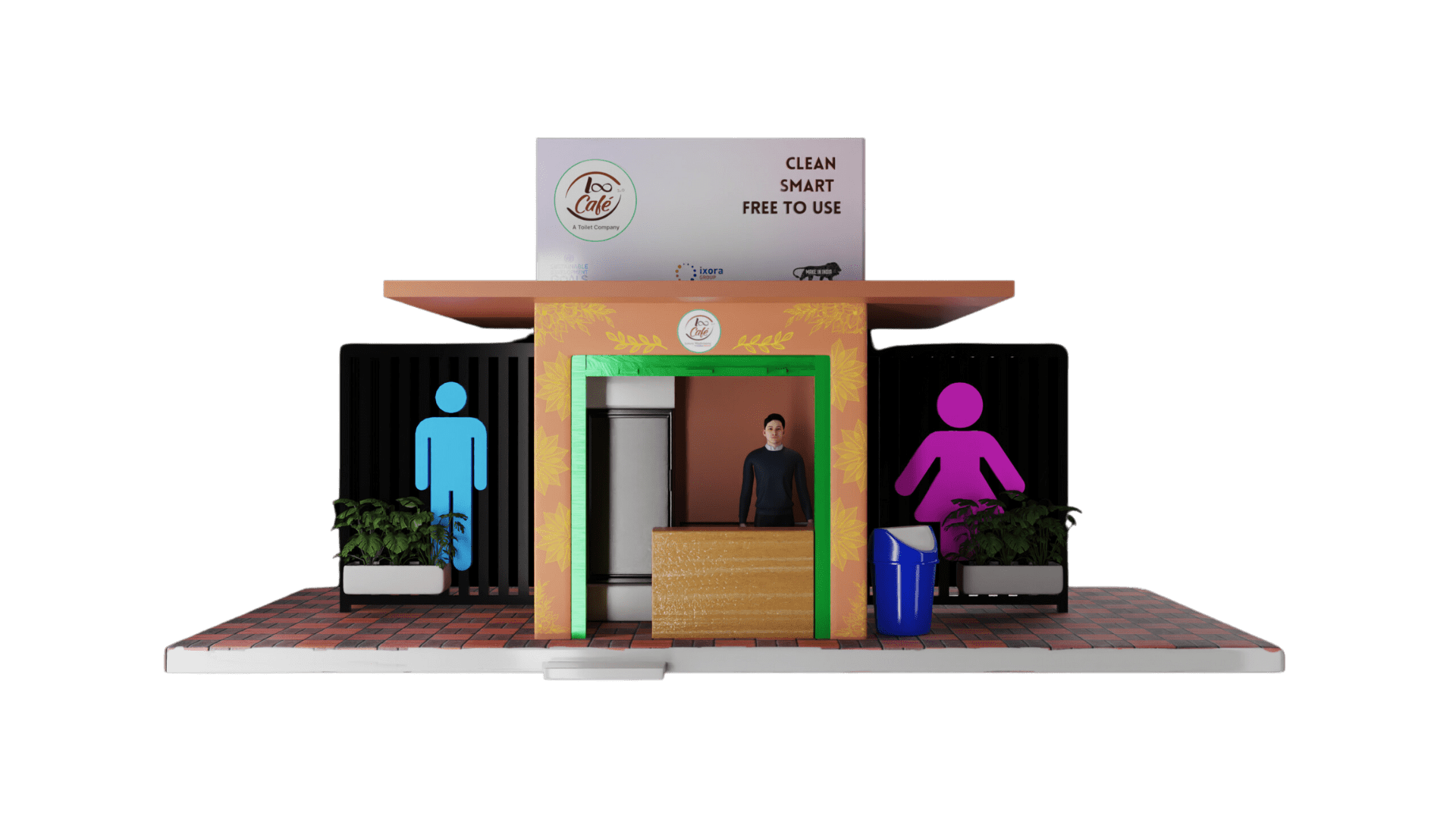
Model 2: The LooCafe Hybrid Model (Café + Toilet)
Innovation: Combine premium public restrooms with café services in single facility.
The Genius: Café revenue subsidizes toilet maintenance—creating self-sustaining sanitation infrastructure.
Structure:
- Container-based construction (modular, rapid deployment)
- Front: Café selling beverages, snacks, meals
- Back: Premium restrooms (clean, well-maintained, safe)
- Staff oversees both, ensuring continuous supervision
Revenue Streams:
- Café Sales (primary): Food, beverages, merchandise
- Advertising (secondary): Facility exterior, digital screens
- Partnerships (tertiary): WiFi, mobile charging, vending
- Potential Future: Franchise fees as model scales
Cost Structure:
- Fixed Costs: Container purchase/lease, installation, utilities
- Variable Costs: Staff salaries, inventory (food/beverages), cleaning supplies
- Maintenance: Continuous (built into operating budget)
Profitability:
- Café gross margins: 60-70% typical in food service
- Net margins: 20-25% achievable with efficient operations
- Toilet maintenance funded from café profit
- Excess profit enables network expansion
Scale Achievement:
- 270+ locations across India (Telangana, J&K, Tamil Nadu)
- Serving millions of users annually
- Proving model viability across diverse contexts
Advantages:
- Financial Sustainability: Doesn't depend on government budgets or user fees
- Quality Maintenance: Café success requires clean facilities (aligned incentives)
- User Experience: Premium feel, continuous supervision, safe environment
- Scalability: Container-based construction enables rapid replication
- Employment: Dignified jobs for café and cleaning staff
Challenges:
- Higher initial capital (café + toilet construction)
- Requires foot traffic for café viability
- Food service regulatory compliance
- Competition from existing cafés (though toilet access is differentiator)
Why Municipalities Should Partner:
- Zero operational cost for public toilets
- Quality guarantees (LooCafe's brand depends on it)
- Increased property values and foot traffic in area
- Tax revenue from café business
- Replicable across high-traffic locations
Model 3: Franchise Model
Structure: Proven sanitation business licenses its systems, branding, and operational know-how to franchisees.
How It Works:
- Franchisor (e.g., LooCafe future potential): Provides brand, training, supply chain, marketing
- Franchisee: Pays initial franchise fee + ongoing royalties, operates facility
- Customers: Benefit from standardized quality across locations
Revenue for Franchisor:
- Initial franchise fees (₹10-50 lakh per location)
- Ongoing royalties (5-10% of gross revenue)
- Supply agreements (exclusive or preferred)
Benefits for Franchisee:
- Proven business model (reduces risk)
- Brand recognition (attracts customers)
- Operational support (training, marketing, supply chain)
- Faster path to profitability
Example: Social Enterprise Franchises
3S Saraplast (Bangladesh/India):
- Toilet leasing to government or large private sector
- Franchise model for geographic expansion
- Cross-subsidization: High-margin contracts support low-income solutions
Advantages:
- Rapid Expansion: No capital investment from franchisor for each location
- Quality Control: Standardized processes ensure consistent experience
- Local Ownership: Franchisees invested in community success
- Scalability: Can grow to hundreds or thousands of locations
Challenges:
- Franchisee selection and training critical
- Brand reputation depends on every location's performance
- Balancing control with franchisee autonomy
- Initial investment required to prove model before franchising
Model 4: Rental/Leasing Model
Structure: Company owns portable toilets and leases them to events, construction sites, municipalities for monthly or seasonal contracts.
Target Customers:
- Events: Concerts, festivals, weddings, sports events
- Construction Sites: Mandated by labor laws in many countries
- Municipalities: Temporary installations during infrastructure work
- Emergency Response: Disaster relief, refugee camps
Pricing:
- Standard Unit: ₹3,000-8,000/month (India)
- Luxury Units: ₹15,000-30,000/month
- Event Premium: 2-3x normal rates
- Delivery, Setup, Cleaning: Additional fees
Profitability:
- Gross Margins: 60-80%
- Net Margins: 20-25%
- ROI: 14% typical with proper management
Scale Examples:
- Small Operations (10-20 units): ₹15-30 lakh annual revenue, ₹3-7.5 lakh net profit
- Large Operations (200+ units): ₹3+ crore annual revenue
Advantages:
- Recurring Revenue: Predictable monthly income
- Asset Ownership: Toilets depreciate but retain value
- Diverse Customer Base: Reduces dependency on single client
- Scalability: Add units as capital allows
Challenges:
- High initial capital (₹160,000/unit in developed markets)
- Logistics and fleet management complexity
- Cleaning and maintenance labor-intensive
- Seasonal demand fluctuations (events concentrated in certain months)
Model 5: Diversified Revenue Streams
Beyond Usage Fees: Modern public toilet facilities can monetize through multiple channels:
1. Advertising:
- Exterior Walls: Prime real estate in high-traffic areas
- Digital Screens: Inside or outside facility
- Rates: ₹10,000-1 lakh/month depending on location
2. Retail Integration:
- Vending Machines: Snacks, beverages, personal care
- Kiosks: Newspapers, cigarettes, lottery tickets
- Pharmacy/Convenience: Small retail space adjacent
3. WiFi Services:
- Partnership with Telecom: Facility becomes WiFi hotspot
- Revenue Share: Monthly fees from provider
- User Benefit: Increases facility attractiveness
4. Charging Stations:
- Mobile Charging: Pay-per-charge or free with time limit
- EV Charging: Future-forward in vehicle transition areas
- Revenue: Direct user fees or partnerships
5. Water ATMs:
- Filtered Drinking Water: Especially important in India
- Pricing: ₹1-5 per liter
- Volume: High-traffic areas generate substantial revenue
6. Shower/Laundry Services:
- Pay-per-Use: Critical for homeless populations, travelers
- Pricing: ₹20-50 per shower, ₹30-100 per kg laundry
- Social Impact: Dignity services for underserved
7. Event Partnerships:
- Sponsored Facilities: "This toilet brought to you by [Brand]"
- Premium Experience: VIP toilets at events (higher pricing)
- Long-term Contracts: Venue partnerships with annual fees
The Power of Stacking: Facilities with 4-5 revenue streams achieve:
- Higher profit margins (25-35%+)
- Greater resilience (diversification)
- Improved user experience (more services)
- Competitive moats (hard to replicate)
Financial Analysis: Making the Numbers Work
LooCafe Case Study: Container-Based Café + Toilet
Initial Investment (per location):
- Container Purchase/Modification: ₹15-25 lakh
- Site Preparation: ₹3-8 lakh
- Equipment (café + toilet): ₹5-10 lakh
- Initial Inventory: ₹1-2 lakh
- Permits/Licenses: ₹50,000-2 lakh
- Total: ₹25-45 lakh per location
Monthly Operating Costs:
- Staff (3-5 people): ₹1.5-3 lakh
- Rent/Land Lease: ₹20,000-1 lakh (or zero if municipal partnership)
- Utilities (water, electricity): ₹15,000-40,000
- Inventory (food, beverages, supplies): ₹2-4 lakh
- Maintenance: ₹20,000-50,000
- Total: ₹4-8 lakh/month
Monthly Revenue:
- Café Sales: ₹8-20 lakh (depends on location, foot traffic)
- Advertising: ₹10,000-50,000
- Other Services: ₹5,000-20,000
- Total: ₹8.5-21 lakh/month
Monthly Profit:
- Best Case: ₹21 lakh revenue - ₹6 lakh costs = ₹15 lakh profit (gross margin 71%)
- Typical Case: ₹12 lakh revenue - ₹6 lakh costs = ₹6 lakh profit (gross margin 50%)
- Worst Case: ₹8.5 lakh revenue - ₹7 lakh costs = ₹1.5 lakh profit (gross margin 18%)
ROI Calculation (Typical Scenario):
- Initial Investment: ₹35 lakh
- Monthly Net Profit: ₹6 lakh
- Annual Net Profit: ₹72 lakh
- Payback Period: 5.8 months
- Annual ROI: 206%
Sensitivity Analysis:
- High-Traffic Location (malls, transit hubs): Payback 3-6 months
- Medium-Traffic Location (commercial areas): Payback 6-12 months
- Low-Traffic Location (residential areas): Payback 12-24 months or break-even only
The Key Insight: Location is everything. High-traffic locations justify LooCafe model; low-traffic may require different approach (pure toilet with municipal subsidy, smaller format).
Portable Toilet Rental Case Study
Initial Investment (Small Operation, 20 units):
- Units (₹80,000 each): ₹16 lakh
- Truck (used pickup): ₹8 lakh
- Pumping Equipment: ₹3 lakh
- Licensing/Permits: ₹1 lakh
- Marketing: ₹1 lakh
- Total: ₹29 lakh
Monthly Operating Costs:
- Staff (driver + helper): ₹50,000
- Fuel: ₹30,000
- Cleaning Supplies: ₹20,000
- Maintenance: ₹15,000
- Insurance: ₹10,000
- Total: ₹1.25 lakh/month
Monthly Revenue (Average 15 units rented):
- Rental Fees (₹5,000/unit/month): ₹75,000
- Delivery/Setup Fees: ₹15,000
- Total: ₹90,000/month
Monthly Profit:
- ₹90,000 revenue - ₹1.25 lakh costs = -₹35,000 (loss in early months)
- As utilization increases to 18/20 units: ₹1.08 lakh revenue - ₹1.3 lakh costs = -₹22,000 (nearly break-even)
- Full Utilization (20/20): ₹1.2 lakh revenue - ₹1.35 lakh costs = -₹15,000 (still marginal)
The Reality: Rental model requires scale. At 20 units, margins thin. At 100+ units:
- Utilization improves (larger fleet, more customer options)
- Fixed costs (truck, staff) spread across more units
- Bulk purchasing reduces unit costs
- Net margins reach 20-25%
Takeaway: Rental model best for scaling to 100+ units or niche markets (luxury portable toilets for events at premium pricing).
Municipal ROI: Why Governments Should Invest
Municipality Perspective: Even without direct revenue, public toilets generate positive ROI through:
1. Health Cost Savings:
- Reduced Disease Burden: Every ₹1 spent on sanitation saves ₹5+ in healthcare
- Diarrheal Disease: Costs ₹10,000-50,000 per case (treatment + lost productivity)
- City of 1 Million: Adequate sanitation could save ₹100+ crore annually
2. Tourism Revenue:
- Clean cities attract tourists
- Tourism Impact: ₹2 lakh crore industry in India
- Cities with poor sanitation lose tourist revenue
3. Property Tax Revenue:
- Improved sanitation increases property values
- Higher property values = higher tax base
- Multiplier effect: Businesses locate in clean areas
4. Business Activity:
- Foot traffic to shopping areas increases with toilet access
- Women spend more time in public (shopping, dining) when safe toilets available
- Commercial tax revenue increases
5. Worker Productivity:
- City residents healthier, more productive
- Businesses benefit from reduced sick days
- Economic output increases
6. Reputation and Investment:
- Clean cities attract corporate investment
- "Ease of Living" rankings improve (NITI Aayog India)
- Smart City designation benefits
PPP Model ROI:
- Municipal Investment: Land provision (zero cash cost)
- Private Investment: ₹30-50 lakh per facility
- Municipal Benefit: Free public toilet + economic spillover effects
- Private Benefit: Café revenue + advertising
- Net ROI for Municipality: ∞ (no cash investment, all benefits)
The Numbers: For a city of 1 million people:
- Need: 200-300 public toilets (WHO recommendation: 1 per 3,000-5,000 people)
- Traditional Cost: ₹100-150 crore (government builds and maintains)
- PPP Model Cost to Government: ₹0-20 crore (land value)
- Savings: ₹80-130 crore
- Plus: Economic benefits (health, tourism, property values)
Why Municipalities Should Partner with LooCafe
The Value Proposition
For Municipalities:
1. Zero Capital Investment:
- LooCafe finances construction
- Municipality provides land lease (often at nominal rate)
2. Guaranteed Quality:
- LooCafe's brand depends on clean facilities
- Continuous staff supervision
- Performance incentives aligned
3. No Operational Burden:
- LooCafe handles maintenance, cleaning, staffing
- Municipality focuses on regulation, not operations
4. Economic Development:
- Café creates jobs (3-5 per location)
- Increased foot traffic benefits nearby businesses
- Property values appreciate
5. Social Impact:
- Safe sanitation for women, children, elderly, disabled
- Menstrual hygiene management facilities
- 24/7 access in many locations
6. Scalability:
- Proven model across 270+ locations
- Rapid deployment (weeks, not months)
- Standardized quality
7. Innovation Leadership:
- Municipality partners with an award-winning sanitation innovator
- Smart City credentials
- Thought leadership in sustainable sanitation
The Partnership Structure
Municipal Role:
- Identify high-traffic locations
- Provide land lease (5-10 year initial term, renewable)
- Facilitate permits and approvals
- Promote facilities to citizens
LooCafe Role:
- Finance and construct facility
- Hire and train staff
- Operate café and maintain toilets
- Marketing and branding
- Technology integration (IoT, apps)
Revenue Sharing (optional):
- Municipality could receive % of café revenue
- Or fixed annual land lease payment
- Or zero payment in exchange for social impact
Performance Metrics:
- Cleanliness standards (surprise inspections)
- User satisfaction surveys
- Operating hours compliance
- Safety and accessibility
Contract Term:
- Initial: 5-10 years
- Renewable based on performance
- Exit clauses for both parties
The Expansion Opportunity
Cities Ready for LooCafe Partnership:
Tier 1 Cities:
- Delhi, Mumbai, Bangalore, Kolkata, Chennai
- High foot traffic, sanitation challenges
- Smart City missions seeking PPP solutions
Tier 2 Cities:
- Pune, Ahmedabad, Jaipur, Lucknow, Kochi
- Growing populations, tourism
- Infrastructure gaps
Transit Hubs:
- Railway stations (Indian Railways partnership potential)
- Bus terminals (state transport corporations)
- Metro stations (metro rail corporations)
- Airports (less priority, existing facilities)
Tourist Destinations:
- Jaipur, Varanasi, Goa, Udaipur
- Clean toilets critical for tourism growth
- International visitor expectations
Educational Institutions:
- Universities, college campuses
- High-traffic, captive audience
- Students value café + toilet combo
Commercial Complexes:
- Shopping malls, office parks
- Supplement existing facilities
- Premium experience justifies location
Event Venues:
- Stadiums, convention centers, fairgrounds
- Permanent LooCafe installations
- Higher traffic during events
Risk Mitigation: What Could Go Wrong (And How to Prevent It)
Risk 1: Low Café Sales
Scenario: Foot traffic lower than projected; café doesn't generate sufficient revenue.
Mitigation:
- Site Selection: Rigorous traffic analysis before location approval
- Pilot Projects: Test demand before full rollout
- Marketing: Aggressive promotion of new locations
- Menu Optimization: Adapt to local tastes and price points
- Secondary Revenue: Diversify beyond café (advertising, retail)
Risk 2: Maintenance Quality Declines
Scenario: Staff performance drops; facilities become dirty, driving users away.
Mitigation:
- Staff Training: Regular refresher courses
- Performance Incentives: Bonuses tied to cleanliness scores
- Mystery Shoppers: Regular unannounced inspections
- User Feedback: App-based ratings and complaints
- Manager Accountability: Facility managers evaluated quarterly
Risk 3: Competitor Entry
Scenario: Other companies copy LooCafe model; market becomes crowded.
Mitigation:
- First-Mover Advantage: Lock in prime locations with long-term leases
- Brand Loyalty: Build strong brand associated with quality
- Franchise Quickly: Scale before competitors establish
- Continuous Innovation: Smart toilets, circular economy, tech integration
- Partnerships: Strategic alliances (municipal PPP and long-term O&M contracts)
Risk 4: Regulatory Changes
Scenario: New regulations increase costs (minimum wage, health standards, taxes).
Mitigation:
- Policy Advocacy: Engage with policymakers proactively
- Industry Association: Form or join sanitation business coalition
- Operational Flexibility: Design processes to absorb moderate cost increases
- Contract Clauses: Pass-through provisions for regulatory cost increases
Risk 5: Economic Downturn
Scenario: Recession reduces café sales; facilities lose money.
Mitigation:
- Diversified Locations: Mix of recession-resistant (transit) and discretionary (tourist) sites
- Cost Structure: High variable costs allow scaling down in downturns
- Reserve Fund: Maintain 6-12 months operating capital
- Municipal Partnerships: Guaranteed minimum payment or subsidy during downturns
The Investment Opportunity: Why Sanitation is Attractive
For Impact Investors
Social Impact:
- SDG 6 alignment (universal sanitation)
- Gender equity (women's safety and participation)
- Public health (disease reduction)
- Worker dignity (fair wages, safe conditions)
- Climate impact (water conservation, potential circular economy)
Financial Returns:
- 15-25% annual ROI typical (LooCafe model)
- Proven at scale (270+ locations)
- Growing market (7-9% CAGR)
- Policy tailwinds (SBM 2.0 funding)
Risk Profile:
- Moderate Risk: Business model proven but scaling challenges remain
- Diversification: Non-correlated with traditional equity/bonds
- Exit Options: Strategic acquisition (larger sanitation/hospitality players), secondary sale, IPO (at scale)
For Venture Capital
Scalability:
- Franchise model enables exponential growth
- Container-based construction reduces capital intensity
- Technology integration (IoT, apps) increases valuation multiples
Market Size:
- India: 1.4 billion people, ₹1.4 lakh crore SBM 2.0 funding
- Global: USD 6+ billion non-sewered circular sanitation market by 2030
Competitive Moats:
- Brand recognition (CII & UNDP recognized)
- Location lock-in (long-term leases)
- Operational expertise (270+ locations)
- Municipal relationships (hard to replicate)
Comparables:
- Food & beverage chains (Starbucks, Dunkin', CCD in India)
- Sanitation businesses (Waste Management, Republic Services in US)
- Smart city tech startups (parking, EV charging, urban infrastructure)
Valuation:
- Revenue Multiple: 2-4x annual revenue (typical F&B)
- EBITDA Multiple: 8-12x EBITDA (typical infrastructure/services)
- Example: ₹100 crore revenue, ₹20 crore EBITDA → ₹160-240 crore valuation
For Municipalities: The "Investment" that Pays for Itself
The Math:
- Municipal Cost: Land lease (often already government-owned)
- LooCafe Investment: ₹30-40 lakh per location
- Municipal Benefit: Free public toilet + economic spillover
Economic Spillover:
- Property values within 500m radius increase 5-10%
- Commercial activity increases (more shoppers with toilet access)
- Tourism revenue increases (cleaner city)
- Health costs decrease (disease reduction)
ROI Calculation (City of 1 million, 100 LooCafe locations):
- Land Value Provided: ₹50 crore (100 sites × ₹50 lakh each)
- LooCafe Investment: ₹350 crore (100 locations × ₹35 lakh each)
- Municipal Savings vs. Traditional Build: ₹80 crore (avoided construction + maintenance)
- Economic Benefits (health + tourism + property): ₹200+ crore annually
- Net ROI: 4:1 or higher
The municipality "invests" land (sunk cost) and gains free infrastructure plus economic multiplier effects.
Call to Action: Partner with LooCafe
For Municipalities
Next Steps:
- Identify Locations: High-traffic areas lacking quality sanitation
- Contact LooCafe: [email protected]
- Pilot Project: Start with 5-10 locations to demonstrate viability
- Scale: Expand to 50-100+ locations across city
- Measure Impact: Track health, economic, and social outcomes
What We Provide:
- Free consultation on site selection
- Financial modeling for your city
- Case studies from existing municipal partners
- Technical support throughout partnership
For Investors
Investment Opportunity:
- Proven Model: 270+ locations, UNDP & CII recognized
- Growth Capital: Expand to 1,000+ locations across India
- Technology Integration: IoT, smart toilets, circular economy pilots
- Franchise Development: Scale through franchisees (capital-light expansion)
- International Expansion: Replicate model in Bangladesh, Indonesia, Philippines, Africa
Target Raise: ₹100-200 crore (Series B)
Use of Funds:
- 50% Location expansion (300-500 new facilities)
- 20% Technology development (IoT platform, mobile app, data analytics)
- 15% Franchise system development (training, marketing, support)
- 10% Working capital (inventory, operational buffer)
- 5% Team expansion (senior management, franchise support)
Contact: [email protected]
For Franchisees
Opportunity:
- Operate LooCafe-branded facility in your city
- Proven business model (removes guesswork)
- Training and ongoing support
- Supply chain and marketing support
Requirements:
- ₹50-75 lakh initial investment (franchise fee + setup)
- Location in high-traffic area (or LooCafe helps identify)
- Commitment to operational standards
- 5-year initial term
Expected Returns:
- Break-even: 6-18 months
- Annual ROI: 25-40% after stabilization
Contact: [email protected]
For Policy Makers
Policy Recommendations:
1. Enable PPPs:
- Streamline approvals for public-private sanitation partnerships
- Standardized contract templates
- Fast-track permitting for proven operators
2. Incentivize Private Investment:
- Tax benefits for sanitation infrastructure (depreciation, GST exemptions)
- Subsidies for smart toilet technology integration
- Climate finance eligibility (green bonds)
3. Land Allocation:
- Reserve spaces in urban plans for public toilets
- Nominal lease rates for social impact projects
- Long-term leases (10-20 years) for private investment security
4. Regulatory Clarity:
- Clear standards for sanitation facilities
- Faecal sludge management guidelines
- Water reuse regulations (enable circular economy)
- Worker safety mandates (enforce NAMASTE scheme)
5. Procurement Reform:
- Performance-based contracts (not just lowest bid)
- Outcome metrics (user satisfaction, not just toilet count)
- Long-term concessions (not annual contracts)
Conclusion: Sanitation as Business, Not Charity
The era of treating public toilets as charitable infrastructure is over. Sanitation is a business—and a good one.
The numbers prove it:
- $5+ return for every $1 invested
- USD 35+ billion global market by 2032
- 20-25% net margins achievable with smart business models
- 270+ LooCafe locations demonstrating profitability and impact
The models prove it:
- PPPs eliminate municipal capital requirements
- Café integration creates self-sustaining revenue
- Franchising enables rapid scaling
- Diversified revenue (advertising, retail, WiFi) boosts margins
The demand proves it:
- 3.4 billion people lack safely managed sanitation
- Urbanization creating unprecedented need
- Government funding (₹1.4 lakh crore SBM 2.0 in India)
- Climate finance flows to green infrastructure
Public toilets can be clean, sustainable, dignified, profitable, and scalable.
LooCafe has proven it with 270+ locations and counting. Now we're ready to scale—to 1,000+ locations across India and beyond.
The business case is clear. The social impact is undeniable. The market opportunity is massive.
The question isn't whether sanitation is a viable business. The question is: Will you be part of the revolution?
About LooCafe: Founded in 2018, LooCafe operates 270+ premium public restroom-café facilities across India. We're proving that sustainable, dignified, profitable sanitation is possible at scale—and we're just getting started.
Partner With Us:
- Municipalities: [email protected]
- Investors: [email protected]
- Franchisees: [email protected]
Sources: World Bank WASH Economics, WHO ROI Studies, Fortune Business Insights (portable toilet market), Arizton (smart toilet market), Toilet Board Coalition, Swachh Bharat Mission reports, GARV Toilets, ServiceCore profitability data
Keywords: public toilet business model, PPP sanitation, LooCafe franchise, sanitation ROI, public toilet profitability, sustainable sanitation, café toilet hybrid, municipal partnerships, sanitation investment, toilet market growth, Swachh Bharat PPP, container-based sanitation, social enterprise sanitation
Subscribe to our Insights
Get the latest updates on sanitation technology and urban policy.