The $260 Billion Problem: Why Public Sanitation is the World's Most Overlooked Crisis
The $260 Billion Problem: Why Public Sanitation is the World's Most Overlooked Crisis
When was the last time you thought about the public toilet you used? If you're like most people, the answer is "never"—unless it was dirty, broken, or non-existent. Yet this seemingly mundane infrastructure represents one of humanity's most pressing challenges, costing the global economy a staggering $260 billion annually in healthcare costs, lost productivity, and premature deaths.
The Numbers Don't Lie: A Global Emergency
Let's start with the sobering reality:
- 3.4 billion people lack safely managed sanitation services globally—that's nearly half the world's population
- 354 million people still practice open defecation, risking disease and dignity
- 500 million women and girls lack adequate facilities for menstrual hygiene management
- Every dollar spent on sanitation returns more than five dollars in economic benefits
The World Health Organization estimates that poor sanitation is directly linked to the transmission of diseases such as cholera, diarrhea, dysentery, hepatitis A, typhoid, and polio. In low-income countries, inadequate sanitation claims thousands of lives daily—predominantly children under five.
Why Public Toilets Matter More Than You Think
The Economic Case
The $260 billion annual loss isn't just a statistic—it represents:
Healthcare Costs: Treating waterborne diseases and sanitation-related illnesses Lost Productivity: Workers sick from preventable diseases can't contribute to the economy Premature Deaths: The economic value of lives lost to diarrhea, malaria, and other sanitation-related diseases Tourism Impact: Cities with poor public sanitation discourage visitors and business travelers
Studies show that open defecation-free (ODF) households save approximately ₹50,000 annually on health expenses. In India alone, achieving universal sanitation could add billions to the GDP while saving millions of lives.
The Social Justice Case
Access to clean, safe toilets is fundamentally a human rights issue:
Gender Equity: Women and girls face unique vulnerabilities without access to safe, private facilities. Lack of menstrual hygiene management facilities keeps 500 million women from full participation in education, work, and public life.
Worker Dignity: An estimated 5+ million sanitation workers in India alone maintain our toilets and sewers—often without adequate safety equipment. Between 2019-2023, 377 sanitation workers died during sewer and septic tank cleaning operations in India.
Social Inclusion: People with disabilities, elderly citizens, and parents with young children are systematically excluded from public spaces when accessible toilets are absent.
The Environmental Case
Sanitation isn't just a social issue—it's an environmental and climate crisis:
- 1.3% of global greenhouse gas emissions come from sanitation and wastewater management
- 4.7% of global methane emissions are attributed to non-sewered sanitation
- Yet only 0.3% of global climate finance goes to WASH (Water, Sanitation, and Hygiene) initiatives
Inadequate sanitation contaminates groundwater, pollutes rivers, and degrades ecosystems. In India, where 70% of households rely on onsite sanitation (pit latrines, septic tanks), untreated fecal sludge frequently ends up in open drains, agricultural fields, and water bodies—creating cascading environmental damage.
The SDG 6 Gap: We're Not on Track
The United Nations' Sustainable Development Goal 6 (SDG 6) aims to "ensure availability and sustainable management of water and sanitation for all" by 2030. But progress is alarmingly slow:
Current Reality (2024):
- Only 58% of the global population has access to safely managed sanitation (up from 48% in 2015)
- At current rates, we need to accelerate progress 5-fold to meet 2030 targets
- Low-income countries need an 18-fold increase in current rates to achieve basic sanitation access
India's Challenge:
- 71% basic sanitation coverage (2019 data)
- 54% safely managed sanitation
- Studies suggest approximately 52% of rural population may still practice open defecation despite official ODF (Open Defecation Free) declarations
The gap between "basic" and "safely managed" sanitation is crucial. A toilet that drains into an open pit contaminating groundwater is "basic" but not "safely managed." True sanitation requires proper treatment of human waste—not just a place to deposit it.
The Business Model Problem: Why Public Toilets Fail
Municipalities struggle to maintain public toilets because traditional models treat them as cost centers rather than sustainable services:
Common Problems:
- Insufficient funding for maintenance
- No incentive for cleanliness
- Stigma associated with sanitation work
- Poorly designed facilities that deteriorate quickly
- User avoidance creates vicious cycle (dirty toilets → fewer users → less funding → dirtier toilets)
This is where innovative models become crucial.
How LooCafe is Part of the Solution
LooCafe was founded in 2018 by Abhishek Nath to reimagine what public sanitation could be. The model is deceptively simple but revolutionary:
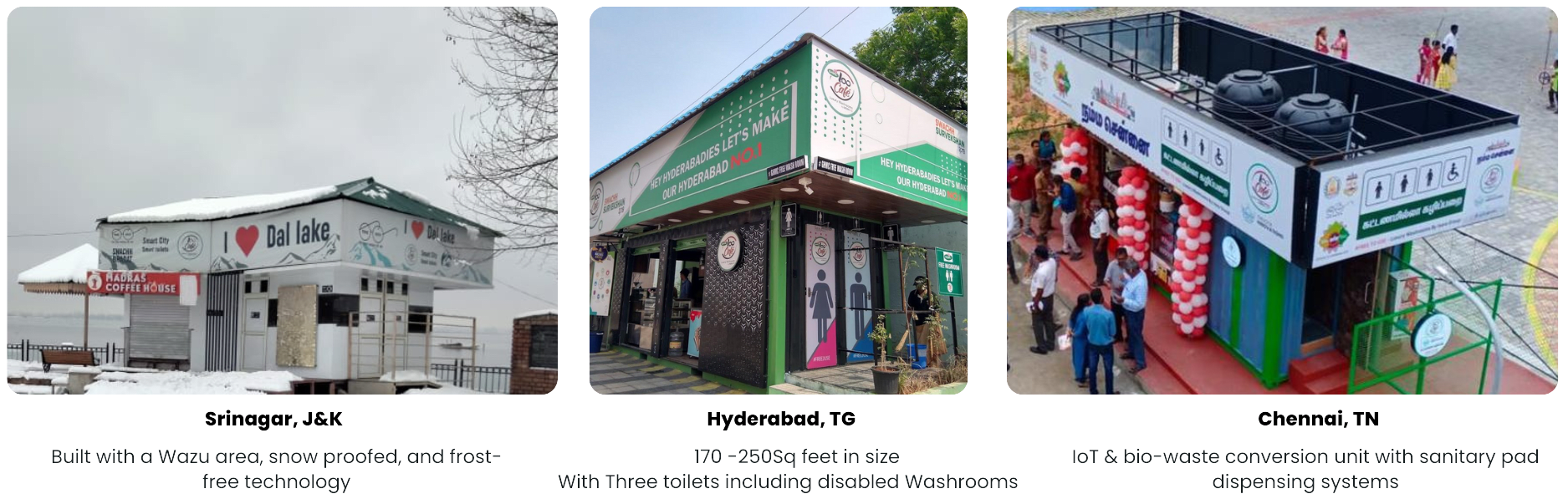
The Hybrid Approach: Instead of standalone toilets dependent on government funding, LooCafe combines premium public restrooms with café services. The café generates revenue that sustains toilet maintenance—creating a self-sustaining sanitation ecosystem.
Container-Based Construction: Built from shipping containers, LooCafe facilities are:
- Rapidly deployable: Installation in weeks, not months
- Standardized quality: Factory-built consistency
- Scalable: Easy replication across cities
- Adaptable: Modular design accommodates different locations
Dignity-Centered Design: Unlike dingy public toilets, LooCafe facilities are:
- Well-lit and clean
- Staffed and maintained continuously
- Accessible to people with disabilities
- Safe for women and children
- Equipped with modern amenities
Proven Scale: With 270+ locations across Telangana, Jammu & Kashmir, and Tamil Nadu, LooCafe has demonstrated that public sanitation can be both profitable and dignified.
The Way Forward: From Cost to Investment
Solving the global sanitation crisis requires fundamentally reframing how we think about toilets:
1. Recognize the ROI
Every $1 invested in sanitation returns $5+ in economic benefits. This isn't charity—it's one of the highest-return investments governments can make.
2. Enable Private Sector Innovation
Public-Private Partnerships (PPPs) like LooCafe's model demonstrate that private enterprise can solve public problems when properly structured.
3. Prioritize Worker Safety
The NAMASTE scheme (National Action for Mechanised Sanitation Ecosystem) launched in 2023 aims to eliminate manual scavenging and ensure sanitation worker dignity. Private sector leaders must adopt these standards.
4. Integrate Technology
Smart toilets with IoT sensors can:
- Predict maintenance needs before failures occur
- Optimize cleaning schedules based on usage data
- Provide real-time availability information to users
- Track performance metrics for accountability
5. Connect Sanitation to Climate Action
Sanitation facilities that capture biogas, recycle water, and operate on solar power can be climate-positive infrastructure—not just waste disposal.
6. Design for All Users
Universal design principles ensure toilets serve everyone:
- Women need safe, private spaces with menstrual hygiene support
- People with disabilities require accessible facilities
- Parents need diaper-changing stations
- Elderly users benefit from grab bars and clear signage
A Solvable Crisis
The $260 billion sanitation crisis is overwhelming—but it's also solvable. We have the technology, business models, and funding mechanisms. What's missing is political will, public awareness, and sustained commitment.
Every time you use a clean, safe public toilet, you're experiencing what should be a universal human right. Every time you encounter a facility that's locked, filthy, or non-existent, you're seeing evidence of a policy failure.
LooCafe's 270+ locations prove that another way is possible. Clean, sustainable, dignified public sanitation isn't a luxury—it's achievable right now.
The question isn't whether we can solve the sanitation crisis. The question is whether we have the collective will to make it a priority.
Take Action
For Municipalities: Explore PPP models that make sanitation sustainable. Contact LooCafe to learn how our approach can work in your city.
For Businesses: Sponsor clean toilet access in high-traffic areas. Every facility you support helps thousands of people daily.
For Citizens: Advocate for clean, accessible public toilets in your community. Use municipal feedback systems to report issues.
For Investors: The portable toilet market is projected to grow from USD 19.2 billion (2024) to USD 34.69 billion (2032). Sanitation is both a moral imperative and a market opportunity.
The world's most overlooked crisis deserves our attention—and our action.
About LooCafe: With 270+ locations across India, LooCafe is revolutionizing public sanitation by combining premium restrooms with café services, creating sustainable, dignified facilities that serve millions annually.
Sources: World Health Organization, UNICEF-WHO Joint Monitoring Programme, World Bank WASH Initiative, Swachh Bharat Mission, India Ministry of Jal Shakti
Keywords: public sanitation, sanitation crisis, economic impact of poor sanitation, SDG 6, open defecation, LooCafe, Swachh Bharat Mission, WASH, public toilets India, sanitation ROI, toilet infrastructure
Subscribe to our Insights
Get the latest updates on sanitation technology and urban policy.